
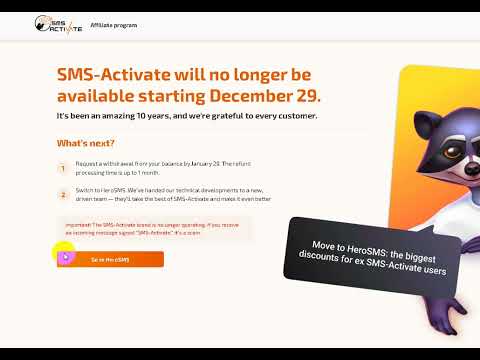
In the digital age, privacy and accessibility are paramount for users across the United States. Whether you are managing multiple social media accounts for business growth, testing new software, or simply protecting your primary phone number from potential spam, the need for secondary authentication methods has become increasingly clear. The SMS activate service provides a streamlined solution for individuals and organizations looking to navigate the complexities of account registration and identity verification without compromising their personal contact information. Understanding how these tools function within the landscape of digital security is essential for anyone aiming to optimize their online workflows.
Understanding the SMS Activate Service
The SMS activate service operates by providing users access to virtual phone numbers that can receive short message system (SMS) traffic from various online platforms. In a typical scenario, a user registers for a digital service that requires a phone number for two-factor authentication or account confirmation. Instead of utilizing their personal mobile device—which could lead to unwanted tracking or privacy risks—the user employs a temporary number provided by the service to complete the handshake process.
For users located in the United States, managing these digital identities requires a reliable, responsive, and secure provider. The ecosystem of temporary number reception has evolved significantly to accommodate diverse requirements, ranging from bulk account creation for marketing campaigns to simple one-off verifications for niche applications. By separating your online activity from your private telephony data, you establish a more robust barrier against unwanted marketing communications and potential data leaks, making the service an essential component of modern internet hygiene.
Core Functionality and Mechanisms
At its core, the functionality of an SMS activate service relies on a wide network of international and local mobile infrastructure. When a user requests a number for a specific app or service, the provider assigns an active, non-VoIP or verified number that is capable of passing the platform’s security checks. Once the message is sent to that number, it is captured by the provider’s infrastructure and displayed on the user’s dashboard, allowing them to extract the verification code quickly.
The speed and reliability of these messages are critical. Modern digital platforms have become increasingly sophisticated in detecting virtual number providers, often blocking common data center prefixes. A high-quality provider mitigates this by maintaining a rotating pool of numbers sourced from genuine mobile carriers. When you are ready to manage your verification sessions, you can use the official sms activate login to access your management panel, monitor incoming logs, and ensure that your authentication workflows remain uninterrupted throughout your operations.
Business Use Cases and Scalability
Businesses operating in the United States often leverage these services to perform tasks that were previously impossible to scale. For social media marketing teams, managing hundreds of accounts for client projects requires a secure and automated way to handle verifications. By utilizing virtual numbers, companies can organize their account infrastructure efficiently without relying on physical SIM cards, which are logistically burdensome and expensive to maintain at scale.
Beyond marketing, these services are frequently used for software testing, penetration testing, and competitive research. Developers testing an application’s signup flow need to verify that it functions correctly for various regional user segments. Automated scripts can interact with the API of an SMS activate service to pull verification codes programmatically, significantly reducing the manual overhead associated with quality assurance. This level of automation is mandatory for agencies that maintain diverse software deployments and need real-time data to troubleshoot sign-up barriers for their clients.
Navigating the Platform and Security
Security is the foundation of any reliable verification provider. Users must prioritize platforms that offer encrypted connections, transparent data handling policies, and clear terms of service. When engaging with an SMS activate service, evaluate the interface for intuitive navigation and robust logging features that help you track which numbers have been used for which platforms. A dashboard should provide clear insights into the status of active processes and the historical usage of your account credits.
For those managing high-volume operations, the security of their credentials is equally critical. Implementing strong, unique passwords and, where possible, enabling two-factor authentication on your account dashboard adds a layer of protection against unauthorized access. Because a breached account could potentially lead to the loss of your verified platform accounts, treating your dashboard access with the same rigor you apply to your primary email address is a professional necessity that should never be ignored or bypassed.
Choosing the Right Virtual Numbers
Selecting the correct number depends entirely on the specific platform you intend to register with. Some applications are more stringent than others, requiring numbers that appear to be associated with specific regional carriers. When choosing a number, consider the following factors to ensure a successful verification process:
- Regional relevance: Does the platform require domestic numbers or are international ones acceptable for your specific verification needs?
- Carrier type: While many services provide generic virtual numbers, some platforms explicitly forbid them; look for providers that advertise mobile-derived connectivity.
- Persistence: Determine if you need a one-time code for registration or if you require an ongoing capability to receive messages for long-term account management.
- Cost-per-verification: High-trust numbers may command a premium price compared to standard shared number pools, so evaluate your budget against the sensitivity of the account.
Best Practices for Account Integrity
Maintaining the integrity of accounts created via SMS activate services requires discipline and a structured approach. Once an account is secured, it is advisable to link it to a reputable recovery email address that is not shared across other volatile platforms. This ensures that even if the temporary number expires, you maintain control over the account identity. Avoid using the same temporary number for multiple critical services, as this creates a single point of failure within your operational architecture.
Furthermore, rotate your usage patterns to avoid flagging your activities as suspicious. Automated systems on major platforms monitor for bulk registrations from specific subnets or timeframes. By spreading out your registrations or using premium proxies alongside your verification service, you improve the longevity of your digital assets. Patience during the setup phase often yields much better retention rates for your managed accounts compared to rushed implementation strategies.
Integration and Automation Workflow
For advanced users, the ability to integrate SMS activation directly into custom applications is a significant advantage. Most reputable services offer APIs that allow developers to trigger number requests, poll for outgoing messages, and complete verifications without ever manually interacting with a website. This integration significantly lowers the friction of scaling projects, particularly when your business model relies on rapid onboarding of new users or constant monitoring of external networks.
Building an effective workflow involves several technical steps:
- Authentication: Securely store your API keys in environment variables rather than hardcoding them into your scripts.
- Request Orchestration: Implement logic to handle request timeouts and ensure your script pauses appropriately if a number is not immediately available.
- Data Parsing: Utilize regex or JSON parsing libraries to cleanly extract the verification code from the raw message body returned by the service.
- Logging and Auditing: Maintain a local database of all numbers used and their associated accounts to simplify future recovery or platform management tasks.
Comparing SMS Reception Solutions
When selecting a provider, you should balance cost, availability, and specific feature sets against your unique requirements. The following table provides a breakdown of considerations for different categories of users looking for verification flexibility.
| Feature | Standard Shared Pool | Private/Dedicated Number |
|---|---|---|
| Cost | Minimal, Pay-per-use | Higher, Monthly subscription |
| Privacy | Moderate | High |
| Platform Compatibility | Limited to mainstream apps | Broad, including specialized services |
| Reliability | Variable | Consistent |
| Best For | Casual users, one-off signups | Business accounts, long-term asset management |
Ultimately, the choice of a service hinges on your specific vertical. If your business operations require high-trust profiles for financial or e-commerce platforms, investing in dedicated numbers is non-negotiable. Conversely, for projects involving temporary, ephemeral data collection or broad-scale software testing, shared pools offer the scalability required to remain cost-effective while keeping your primary assets isolated and secure. Always prioritize services that demonstrate clear documentation and responsive support, as technical issues are inevitable, and having a path to resolution is a mark of a professional-grade provider.
The landscape of telephony verification continues to change as mobile carriers update their security protocols. By staying informed about these trends and opting for service providers that proactively update their infrastructure to match evolving security standards, you can future-proof your digital operations. Whether you are scaling an enterprise-level campaign or protecting your identity as an individual user, understanding the nuances of how these services function is the first step toward efficient and secure digital interaction in the United States.
Warning: count(): Parameter must be an array or an object that implements Countable in /www/wwwroot/nbhyacasting.com/wp-includes/class-wp-comment-query.php on line 405